Goddess imagery is not fixed or timeless, it moves with changing worldviews, bodies, and cosmologies. This essay explores how the presence or absence of the goddess shapes how myth and human consciousness evolve together.
In preparation for my upcoming Goddess Qi Gong course, I find myself returning to books that shaped my understanding of goddess spirituality over many years. As I revisit earlier notes and reflections, what stands out is that Goddess imagery, like embodied practice, is not static. It evolves alongside changing worldviews. Indeed, it is in movement as much as we are.
Today I consider how goddess imagery, or its absence, influences religious worldviews and the ways humans understand themselves, nature and the sacred. This essay is inspired by “The Myth of the Goddess. Evolution of an Image” by Anne Baring and Jules Cashford. Especially its final chapter “The Sacred Marriage of Goddess and God: the Reunion of Nature and Spirit”reflects the dance of apparent opposites that is essential to my work.
The Myth of the Goddess begins with an outline of palaeolithic and neolithic mother goddesses of sky, earth and water. Then there are several chapters that delve into regional specifics of Crete, Egypt, Babylon and Greece. Other chapters discuss archetypal initiations like the life-death-life cycle, the mother goddess and her lover-son, journeys through the underworld, and the sacred marriage in many forms and manifestations.
The authors connect the evolution of consciousness to the journey of the goddess. They ask how consciousness tells its story through these images, and what it means that there is currently no formal goddess myth in western culture.
I missed a female presence in the sober protestant church I grew up in.I often wondered if I had been better able to embrace Christianity in a Catholic context. There, Mary has a much more prominent role as virgin, whore and mother, and the practice of sensory rituals has been kept alive.
At age 8, I realised that it felt limiting and impersonal to only pray to god the father. It took me many years to un-condition myself from this strong dogma, and feel comfortable to pray to god the mother, or simply mother, or goddess. She has always felt closer, more understanding, and I could more intimately relate to her, even as a teenager.
Reflection Question 1:
I’m curious to hear your experience with this. Have you ever questioned who you pray to and tried to change the doctrine, or have your choices always felt natural to you?
Let’s get back to the book… Baring and Cashford describe the presence of the female divine principle in four subsequent phases in Goddess mythology.
In the first phase, the world and everything in it is considered sacred and animated with soul. The world is born from the Great Mother all by herself. All beings come from, and are part of, her divine body, including nature, humanity and other gods. There are no apparent dualities, as everything is considered part of the same identity.
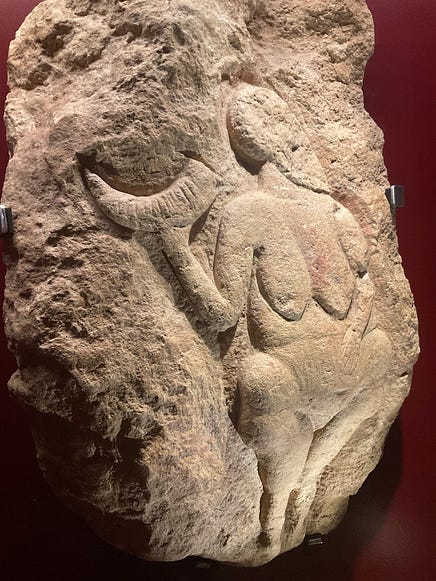 |
This seems to have been the case in paleolithic and neolithic times, and also in bronze-age Crete. Today this view is still prevalent in many contemporary indigenous cultures.
I imagine that this cosmology of a solo-life giver originally emerged because the process of semen fertilising the egg remained mysterious for a long time, since not every action of intercourse results in pregnancy.
The narrative then shifts to the interaction between the Mother Goddess and the God. Born as her son, in time he grows up to become her lover and consort. Everything is still considered alive and sacred, but now there is a perception of change, of time, a difference between eternal and temporal, of seasonal growth and decay. Duality comes in, between “that which endures and that which changes” (p. 660). This leads to a differentiation between energy and form, and later to distinctions of spirit and nature, mind and matter, soul and body.
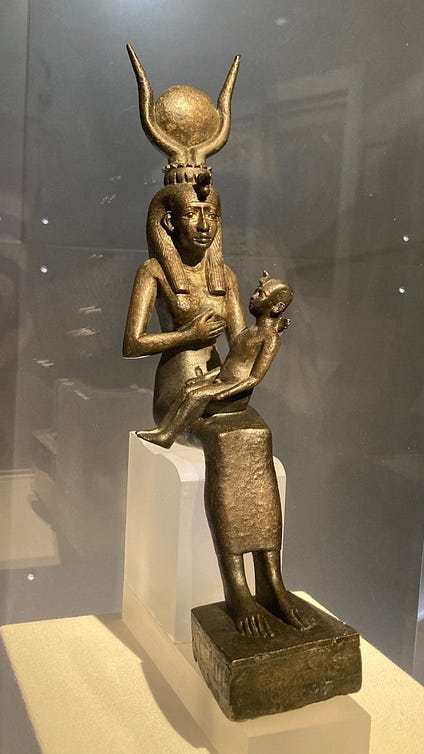 |
Some examples of this phase are the myths of Inanna and Dumuzi (Sumeria), Ishtar and Tammuz (Babylonia), Isis and Osiris (Egypt), Aphrodite and Adonis (Greece), Cybele and Attis (Anatolia).
Reflection Question 2:
Have you heard of the respective consorts? It seems that they are less well known, which would still place the goddess centre-stage in this mythological phase. The creational, life-giving process results from the meeting of the sacred couple. This seems to me closest to the process in nature and in our own bodies. What do you think?
At some point in the relational cycle, the Mother Goddess is killed by the God. He then creates the world from her dead body. For example, the body of Tiamat, the Babylonian goddess of the Bronze and Iron Age, was split to create heaven and earth. Here, creation becomes separate from its creative source.
With it comes a decisive shift in power. Rather than power arising from within, it is now imposed as power over. The world is no longer seen as animate and sacred, but as inert matter that requires ordering by a sovereign, external spirit. In some versions of these myths, the human race is fashioned from the blood of the dismembered consort, further emphasising this rupture between life and its source.
 |
What is not always clear is whether this represents a transformation of the lover-god himself, who takes over creative power through an act of destruction, or whether a third, more abstract divine figure is introduced, who stands apart from the original sacred couple. In the latter case, creation no longer emerges from relationship at all, but from domination and distance, a move that already anticipates the cosmology of the fourth phase below.
Either way, the consequences are similar. Relationship gives way to hierarchy, participation to control. The world is no longer considered as kin. I think this sowed the early seeds of a worldview in which nature, and later the female body, came to be associated with disorder, temptation and sin.
The goddess does not disappear entirely, but survives only as a conquered body, a wild and chaotic force that has to be subdued. At best she lingers as a memory, safely domesticated and reduced to fairy tales and stories that modern culture assumes it has outgrown. If she is remembered at all, it is as a relic of a more ‘primitive’ past, stripped of any sacred authority.
In the final stage, it is a male god who is entirely self-sufficient. He creates the world without any female involvement, tipping the scales after the first phase that only recognised a goddess. Baring and Cashford give many several examples of this, often connected to sound or word.
The Egyptian Atum copulates with himself. The tongue of the Egyptian Ptah “translated the thoughts of his heart” (p.661). The Hebrew Yahweh-Elhom “made heaven and earth in the beginning and saw that it was good” (p.661).
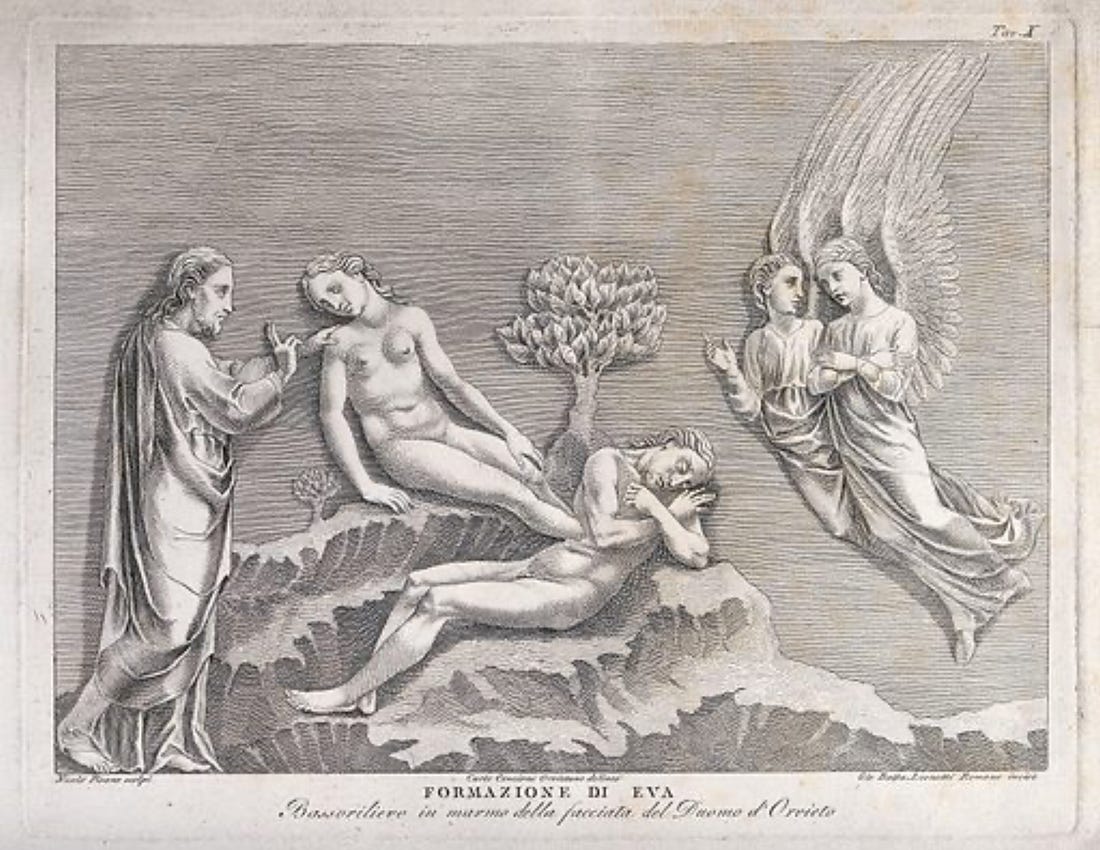
The Christian version (a sub-stream in the fourth phase) separates the world even further from the original creative and sacred source. Adam is first made from inanimate clay, so not from a divine body. He only comes alive when “spirit is breathed into him” (p.661). Eve is then shaped from one of his ribs.
 |
In this view, humans are animated by a disembodied, pure and transcendent spirit. However, animals, plants or minerals remain inanimate. They are referred to as ‘it’, and considered inferior to the spiritual nature of humanity, which at least had been breathed to life by the disembodied god essence.
In the Hebrew, Islamic and Christian traditions, the mother goddess plays no role in creation. Apart from a symbolic role of a ‘virginal’ Mary, she has mostly disappeared into the shadows.
What emerges from these four phases can be read as a gradual suppression of animism, and with it the marginalisation of nature and the feminine principle. This shift reshapes how power, body and the living world are understood, and how humans locate themselves within it.
As goddess imagery eroded, creation became increasingly abstracted, hierarchical, and disembodied. Power over won from power within. The last two phases directly shaped education, religion, governance and other institutional structures for centuries, if not millennia.
Re-addressing the balance to include feminine leadership, other ways of knowing and animist practices will not solve our world issues overnight. Yet remembering our innate power may be a necessary first step. Collective change must begin by making these patterns conscious, and by honouring our female lineages and the power of women in our lives, including ourselves.
Reflection Question 3:
What stage(s) do you most resonate with? Which are similar to your own experience and practice? Which makes you feel uncomfortable or offends you? What emerged for you through this essay? Would Goddess Qi Gong be a small step forward?
References
Baring, Anne and Jules Cashford (1991) The Myth of the Goddess. Evolution of an Image. London: Viking (Penguin Group).
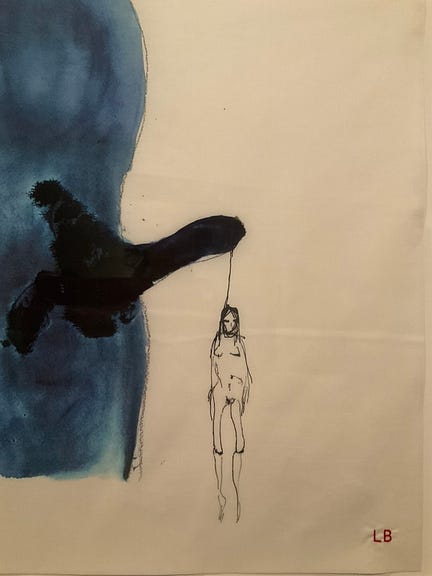
“Do Not Abandon Me is the result of an extraordinary collaboration between Louise Bourgeois and Tracey Emin. Bourgeois painted the original work - flowing silhouettes, pregnant bellies and erections - using red, blue and black gouache. Emin then added small figures and texts with ink and pen. The series reads like a frank dialogue on the complex themes of fertility, loneliness, loss, self-determination, motherhood and the role of the artist. The collaboration illustrates how two artists from different generations share their musings on self-determination, relationships, desires and artistry. Bourgeois, for instance, had limited access to birth control, unlike Emin, who is frank about it in her work.” (text from Centraal Museum display, Exhibition Good Moms/Bad Moms) as seen on 18 June 2025 by Eline Kieft).
Earlier versions of this essay appeared in the Feminism and Religion blog and on my Podia Blog.
Met dank voor haar werk
en wil je met deze auteur corresponderen: elinekieft+soul@substack.com