donderdag 3 februari 2022

Natuur verbonden leven in Fichtelgebirge

 Ein Pionier im Fichtelgebirge

Ronald Ledermüller ist ein Mann mit einer Mission: Er will Mensch und Umwelt, Tradition und Moderne im Fichtelgebirge miteinander verbinden. Die Dokumentation begleitet Ronald auf eine Entdeckungsreise in das Naturjuwel mit seinen bizarren Felsformationen und jahrhundertealten Traditionen.

Bis zur Wiedervereinigung Deutschlands lag das Fichtelgebirge im Abseits des Weltgeschehens direkt am Eisernen Vorhang. Viele Junge sind weggezogen. Doch das ändert sich. Auch dank engagierter Visionäre wie Ronald Ledermüller, der als Ranger im Naturpark Fichtelgebirge versucht, für die Natur und die Menschen hier eine Zukunft zu gestalten. Gemeinsam mit Mitstreiterinnen wie der Schäferin Christa Frank ist er dabei, die einst im Fichtelgebirge bestehende Tradition des Textilhandwerks wiederzubeleben. Fast verlorenes Wissen kann dazu Peter Ziegler beisteuern, der in seiner Wollmanufaktur mit viel Aufwand eine über 100 Jahre alte Maschine zur Wollverarbeitung am Laufen hält.

Die Möglichkeiten im Fichtelgebirge ziehen auch immer mehr Kreative an, so hat die Holzbildhauerin Stephanie Huber auf ganz eigene Art hier im Fichtelgebirge Wurzeln geschlagen.

Vor der Kulisse der einzigartigen Felsformationen, die das Fichtelgebirge prägen, folgt die Dokumentation dem charismatischen Ranger Ronald Ledermüller, der die Entwicklung der Region und seiner Menschen zu seiner Herzensangelegenheit gemacht hat.

zie
https://www.arte.tv/de/videos/099714-000-A/ein-pionier-im-fichtelgebirge/?fbclid=IwAR2x_BylpH2HTT3nyCz8c8xdOELSyVWmbPn9t3SvhzQmKnaeHHiM3vWHwlE


woensdag 2 februari 2022

de Verlichte koe


What Are the Qualities of a Seeker of Truth?

What Are the Qualities of a Seeker of Truth?
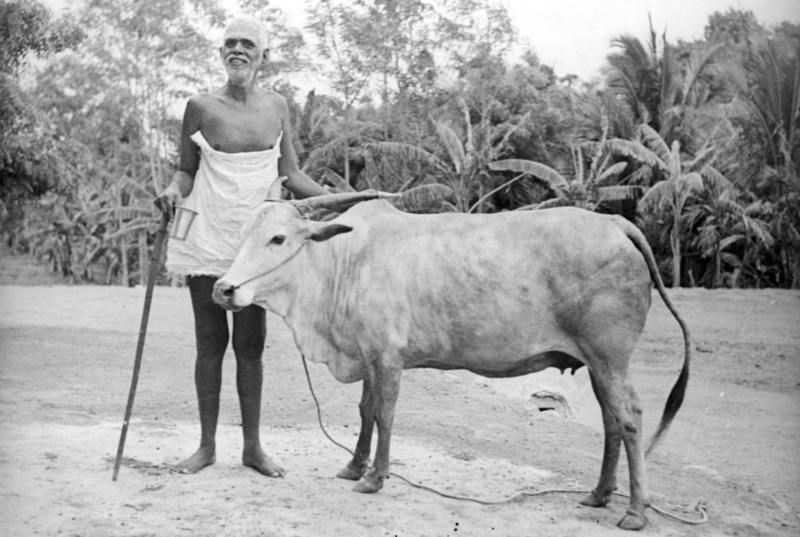
Ramana Maharshi and his cow

Osho,
What are the qualities of a seeker of truth?

Every child is born with an innate search for truth.

“It is not something learned or adopted later on in life. Truth simply means, “I am, but I do not know who I am.” The question is natural – “I must know the reality of my being.” It is not curiosity.

“These are the three differences, or three categories the world can be divided into: there are things which are, but they do not know that they are, hence there is no opening for any inquiry. They are closed, their existence is windowless. Then there are animals who know that they are, but they don’t have the intelligence to inquire what it is that they are. Their windows are open, but their intelligence is not enough to look out and see the stars and the sky and the birds and the trees. Their windows – whether opened or closed – don’t make much difference.

“Perhaps once in a while a rare animal uses the window.

“Shri Ramana Maharshi was one of the most significant people of this century. He was not a master; that’s why people don’t know him as they know George Gurdjieff or J. Krishnamurti. They don’t even know him as they know Sri Aurobindo or P. D. Ouspensky who were only teachers – profound teachers, but not mystics.

“Ramana Maharshi was a silent pool of energy. Every morning he used to sit for a silent satsang, communion. He never talked much, unless asked something. Then too his answer was very short – having profundity, but you had to look for it. There was no explanation in it. His literature is confined to two, three small booklets.

“His teaching was mostly to be in silent communion with the disciples. Naturally, very few people were benefited by him. But every morning he was sitting, people were sitting, and a cow would come and stand outside, putting her neck through the window, and she would remain standing there while the satsang lasted. It must have continued for years.

People came and went, new people came, but the cow remained constant, coming at the exact time, never late.

“As the satsang would disperse she would move away.

“One day she did not appear, and Shri Ramana said, “Today satsang cannot be held, because my real audience is absent. I am afraid either the cow is very sick or she has died, and I have to go and look for her.” He lived on a mountain in the south of India, Arunachal. The cow belonged to a poor woodcutter who lived near the ashram. Ramana left the temple where they used to meet, went to the woodcutter and asked, ‘What happened? The cow has not come today for satsang.’

“The woodcutter said, “She is very sick and I am afraid she is dying, but she goes on looking out of the door, as if she is waiting for someone. Perhaps she is waiting for you, to see you for the last time. Perhaps that is why she is hanging around a little longer.”

“Ramana went in and there were tears in the eyes of the cow. And she died happily, putting her head in the lap of Ramana Maharshi. This happened just in this century. Ramana declared her enlightened, and told his people that a beautiful memorial should be made for her.

It is very rare for human beings to be enlightened; it is almost impossibly rare for animals to become enlightened, but the cow attained.

“She will not be born again. From the body of a cow she has bypassed the whole world of humanity, and she has jumped ahead and joined with the buddhas. So once in a while – there are a few instances only – it has happened. But that cannot be called the rule; it is just the exception.

“Things are, but they do not know that they are. Animals are, they know that they are, but they don’t have the intelligence to ask who they are. And it is not something to be wondered about. Millions of human beings never ask the question – that is the third category.


Bron https://www.oshotimes.com/insights/lifestyle/spirituality/what-are-the-qualities-of-a-seeker-of-truth/

zaterdag 22 januari 2022

schattig


De schat in de akker

Als een meester een beeld maakt uit hout of steen, dan brengt hij het beeld niet in het hout, maar snijdt hij het overtollige hout weg dat het beeld verborgen en bedekt houdt, hij gééft het hout niets, maar hij graaft de korst ervan af en neemt de roest weg, en dan glanst op wat daaronder verborgen lag. Dit is de schat die verborgen lag in de akker, zoals onze Heer in het evangelie zegt (Mt.13:44).

- Meister Eckhart (ca. 1260 - 1328) -

Geciteerd in: W. Jäger, 'De mystieke weg: traditie en ervaring', Nijmegen 1984, p.45-6.

van aangezicht tot aangezicht


 All the physical lines of our bodies, faces and limbs were originally formed and prepared in our brains. There is a terrible, implacable law which decrees that every movement of our thoughts and feelings is eventually expressed on the physical plane. Of course, this does not happen immediately; many different currents flow through our soul in the form of feelings and states of mind and gradually these states are given concrete form in our bodies. Our full potential is contained in the brain, but in our everyday lives, our faces express our active capital, that is to say, what we are currently experiencing.
Only currents that were set in motion a very long time ago and that have been frequently repeated are deeply etched into the structure of our faces. »

Omraam Mikhael Aivanhov

"an Apostle of peace and nonviolence" is in our hearts


 (CNN)Thich Nhat Hanh, a prominent Vietnamese Buddhist monk, peace activist and leading voice in opposition to the Vietnam War, has died at Tu Hieu Temple in Hue, Vietnam. He was 95.

The monastic organization that he founded, Plum Village, announced the news on their website.
Plum Village said Thich Nhat Hanh passed away "peacefully" on Saturday morning local time.
    "Thay [Thich Nhat Hanh] has been the most extraordinary teacher, whose peace, tender compassion, and bright wisdom has touched the lives of millions," the Plum Village statement said.
      "Whether we have encountered him on retreats, at public talks, or through his books and online teachings -- or simply through the story of his incredible life -- we can see that Thay [Thich Nhat Hanh] has been a true bodhisattva, an immense force for peace and healing in the world," it said.
      Thich Nhat Hanh traveled to the US in 1961 to teach comparative religion at Princeton University. Later that decade, he lectured at Cornell and Columbia University, where he continued to spread a message of peace and lobbied Western leaders to end the Vietnam War, Plum Village said.
      In 1967, Dr. Martin Luther King, Jr. nominated Thich Nhat Hanh for the Nobel Peace Prize, calling him "an Apostle of peace and nonviolence." However, no Nobel Peace Prize was awarded that year.
        Thich Nhat Hanh's mission of opposing the war led to both North Vietnam and South Vietnam denying him to the right to return to either nation for decades.
        He was exiled for 39 years and was only given the permission to return to his homeland in 2005.

        gedenk die mannen en vrouwen die om wat voor redenen de strijd willen aangaan

        niet ver van hier -1500 km- staan twee grote legers tegenover elkaar met totaal 500.000 mensen-mannen en vrouwen-  zoals jij en ik. Europeanen, de ene die geloven in vrijheid en de andere in onvrijheid.  Ellende in spe. Pijn, pijn en nog eens pijn als deelgenoot van  de vernietigende krachten op deze planeet.

        Ukrainian soldiers keep watch at their trench position. "One of the soldiers pointed to the horizon and said: 'See that mound? The terrorists are behind that mound,' " photographer Timothy Fadek said. "They refer to the separatists as terrorists."

        Timothy Fadek/Redux for CNN

        woensdag 19 januari 2022

        Kosmos op Aarde


         volop sneeuw boven de 800 m tot wel 20-30 cm dikte. Was vandaag aan het wandelen en wel heel heel erg reinigend in dat Kosmische Gebied. Bij mij rond de 400 m ligt momentaan geen sneeuw maar er komt weer meer.